
KNOWING HOW YOU LEARN BEST
How neurodivergence teaches us how to work more productively and make better decisions.

In March, I was invited to be part of this pretty cool magazine by YCN (You Can Now) - a company based on developing leadership programmes and learning workshops for companies. But most importantly, they see the value in the kooky minds and work with the edges that society has to offer to make it inclusive 🧡. Thank you, YCN, for the interview!
How awesome it is to feel valued for thinking differently. The world needs more of this 🧠

Everything starts with learning. Everything.
It’s all well and good saying that we want more neurodivergent minds in schools, universities and workplaces, but part of this duty is creating an environment that is adapted accordingly, so we can bring these minds to the light. Studies show that over half of employed people have left work due to their neurodivergence, along with over a third admitting that there isn’t enough support in the workplace. It isn’t good enough.
It’s so important to cater to different learning styles as opposed to trying to prescribe the same treatment in the hope it will work for everyone.
I find it odd to see so many companies invest in new technologies foremost, rather than spending more budget on enabling and developing existing minds.
After all, technological innovation without systemic integrity will perpetuate harm - be it experiences within the supply chain or ignoring the people right in front of you who are struggling to learn through narrow teaching methods.
Sustainability is an inclusion issue — because real progress means taking people with you.
The first step in undoing this spiral is listening to different minds so you can work with them. It isn’t about conceding to change, but listening to canaries to make a more inclusive system for all 🐥.
🧠 How I learn differently 🧠
Here’s how I learn differently - it’s a pain for some, but one of the main keys to questioning things that don’t work.
I take things literally, in profuse detail and see connections between things beyond what’s been read to me 👀 Remember, neurodivergent minds are often overwhelmed since we start from 1000, not 0.
I have justice sensitivity, which means I will go off task to solve a seemingly unrelated problem in line with my values, to only to then prevent 5 more. 🌍
I often challenge status quos and KPIs before turning the next page, since I am more focused on solving problems through any combination of discipline or department, as opposed to looking at it through the lens of specific specialisms or skillsets. NB: This is not how most companies operate which can makes things a tad fruity. 😬
I need to understand every part of the question and assumptions before intervening.
I will be bored and disengage when I know something is a dead end (even if I don’t want to). If I can’t question it, it takes a lot of energy to focus.
I need a task to be repeated about 3 more times than desired, often with different steps to position it in the context of a project. The questions I ask will be very basic, but that’s because I see the whole project at a time.
This is my favourite, I have time blindness which means that I will see and conjecture up different outcomes and scenarios (in the space of a few seconds) which unfold over different time frames based on a variety of parameters- from months to years……..yet I will be late for a meeting or not know where to start on a task first.
I could do a whole post series on this, but today is about my interview with YCN!
Here, I talked about my distinctive approach to teamwork, the importance of embracing diverse cognitive styles at work, my efforts to promote inclusive communication for neurodivergent individuals, and the qualities that define a good (and bad) boss.💚
YCN ARTICLE
Here’s my article! Enjoy it with a cup of tea ☕️ or listen to it whilst walking the dog 🐶.
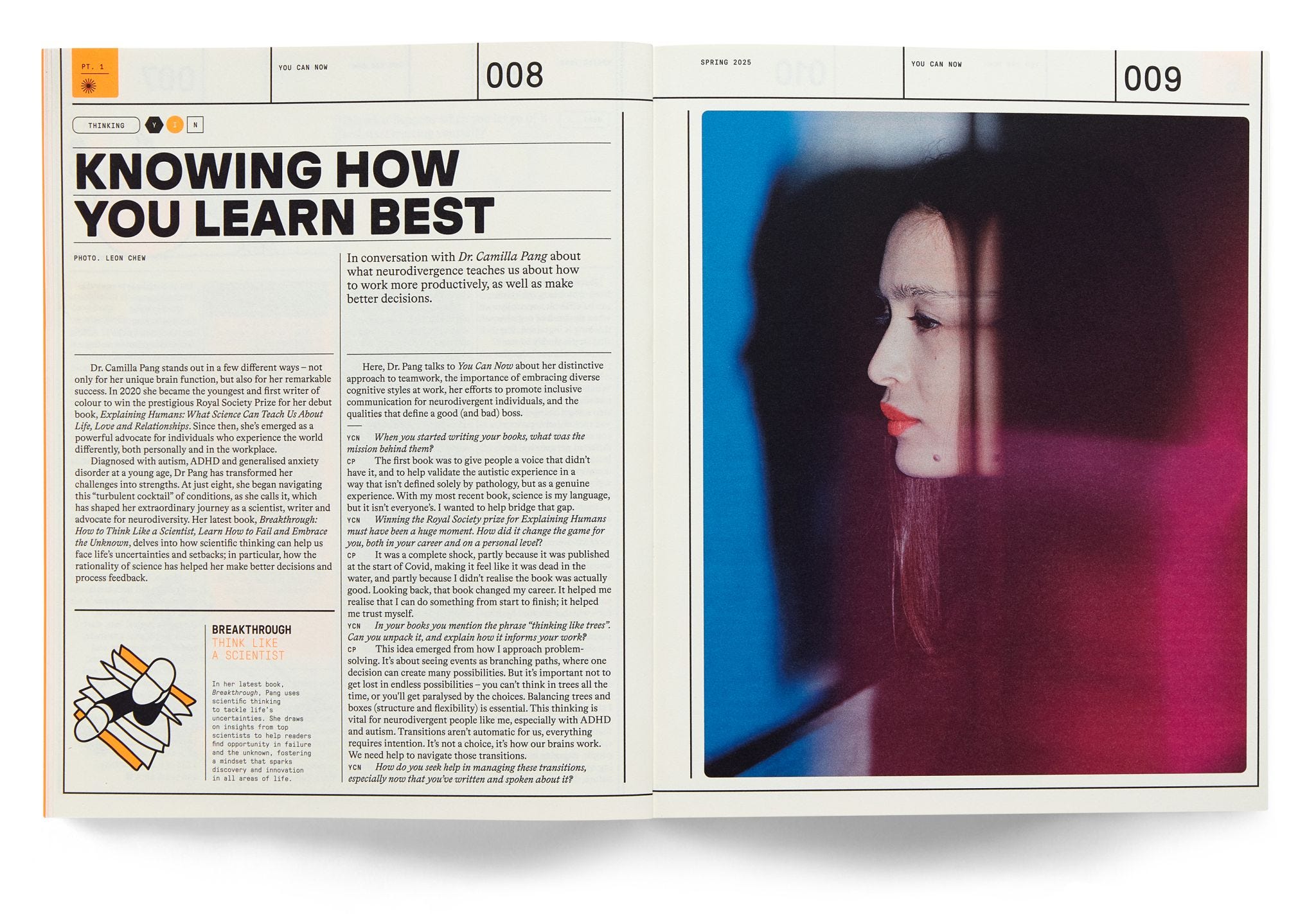
You ready?
Written by John Sunyear.
Dr. Camilla Pang stands out in a few different ways – not only for her unique brain function, but also for her remarkable success. In 2020 she became the youngest and first writer of colour to win the prestigious Royal Society Prize for her debut book, Explaining Humans: What Science Can Teach Us About Life, Love and Relationships. Since then, she’s emerged as a powerful advocate for individuals who experience the world differently, both personally and in the workplace.
Diagnosed with autism, ADHD and generalised anxiety disorder at a young age, Dr Pang has transformed her challenges into strengths. At just eight, she began navigating this “turbulent cocktail” of conditions, as she calls it, which has shaped her extraordinary journey as a scientist, writer and advocate for neurodiversity. Her latest book, Breakthrough: How to Think Like a Scientist, Learn How to Fail and Embrace the Unknown, delves into how scientific thinking can help us face life’s uncertainties and setbacks; in particular, how the rationality of science has helped her make better decisions and process feedback.
YCN — When you started writing your books, what was the mission behind them?
CP — The first book was to give people a voice that didn’t have it, and to help validate the autistic experience in a way that isn’t defined solely by pathology, but as a genuine experience. With my most recent book, science is my language, but it isn’t everyone’s. I wanted to help bridge that gap.
YCN — Winning the Royal Society prize for Explaining Humans must have been a huge moment. How did it change the game for you, both in your career and on a personal level?
CP — It was a complete shock, partly because it was published at the start of Covid, making it feel like it was dead in the water, and partly because I didn’t realise the book was actually good. Looking back, that book changed my career. It helped me realise that I can do something from start to finish; it helped me trust myself.

YCN — In your books you mention the phrase “thinking like trees”. Can you unpack it, and explain how it informs your work?
CP — This idea emerged from how I approach problem-solving. It’s about seeing events as branching paths, where one decision can create many possibilities. But it’s important not to get lost in endless possibilities – you can’t think in trees all the time, or you'll get paralysed by the choices. Balancing trees and boxes (structure and flexibility) is essential. This thinking is vital for neurodivergent people like me, especially with ADHD and autism. Transitions aren’t automatic for us, everything requires intention. It’s not a choice, it’s how our brains work. We need help to navigate those transitions.
YCN — How do you seek help in managing these transitions, especially now that you’ve written and spoken about it?
CP — It’s both a continuous learning process and something I will always need help with. My second book emerged after I processed the emotional side of my first one and questioned existing assumptions, particularly in science. People with neurodiversity never have everything figured out, especially if you’re a woman, because you have more fluctuating factors like the menstrual cycle you have to deal with. Today it means this, tomorrow that. You’re constantly having to engineer what the day looks like and how you will respond. It’s tiring. So we need support from understanding people, whether in a family, workplace, or team. I’m lucky to have a supportive partner and family, but I also rely on the understanding of colleagues, supervisors, managers.
"I find that disagreement can be productive if it leads to better ideas. I'm someone who enjoys playing devil's advocate."
— Dr. Camilla Pang

In her latest book, Breakthrough, Pang uses scientific thinking to tackle life’s uncertainties. She draws on insights from top scientists to help readers find opportunity in failure and the unknown, fostering a mindset that sparks discovery and innovation in all areas of life.
YCN — Communicating your needs to the people you work with must be extra important…
CP — Kindness and mutual respect are key. It’s important for bosses and colleagues to give us the benefit of the doubt. For instance, when I make a mistake, it should be seen as part of the process, not as a flaw in my character. The work environment plays a huge role, especially in startup cultures where productivity is often prioritised over individual needs. The most supportive bosses are those who recognise that mistakes are part of the journey and who offer clear, actionable support without making us feel like we’re asking for too much. I need a boss who sees me as a human, who is funny, who’s got humility, who acts like this even if I am a contractor, because a lot of people who are neurodivergent are contractors. A boss who says, “It’s alright to make a mistake. I find this task difficult too. Don’t worry Mills, it’s part of the process.”
YCN — Do you communicate openly about your neurodivergence with potential employers or teams?
CP — Yes, I find it’s better to disclose early. You might not get as many job offers, but the ones you do get will be more likely to accommodate your needs. I’ve found that being transparent about my neurodivergence, including specific needs like longer explanations or breaks during meetings, helps set clear expectations. However, even if a company says they’re inclusive, it doesn’t always play out that way. It’s crucial to know your rights, especially if discrimination arises later on.
YCN — How do you navigate situations where you ask for accommodations, but it still feels like discrimination?
CP — It’s important to clearly communicate your needs upfront, as this gives you legal standing if issues arise later. For example, I might ask for small adjustments like being relocated to a quieter room if there’s a beeping noise or for meetings to be shorter. Even when you’re explicit about these requests, there’s still a risk of discrimination if it’s not respected. That’s why it’s important to disclose early and hold the company accountable.
YCN — Any more examples of how these accommodations work in practice?
CP — A good example would be meetings. I struggle with progress meetings because they often feel superficial. I need more time to break down complex ideas and sometimes just need to ask basic questions that others may assume I know. Having a boss who understands this and lets me take the time I need to fully understand the task helps me perform better. It’s about knowing how you learn best and ensuring your team respects that.
YCN — How does your neurodivergence affect how you work with others in a team?
CP — It’s a two-way street. Neurodivergent individuals must understand their own needs, and similarly, coworkers and bosses should understand how to communicate effectively with us. For example, I might not always know how I’m feeling (alexithymia), but I’ve learned to track how I respond to different situations. It’s a process of trial and error. Reading about neurodivergent experiences and learning about other people’s needs has helped me refine how I communicate in the workplace.
YCN — You’ve talked about how science has helped you understand teamwork. Can you elaborate on that?
CP — In science, teamwork is essential. Scientific research never happens in isolation, and even the most brilliant ideas rely on feedback from others. This continuous cycle of feedback and collaboration helps refine ideas. However, the dynamics can differ depending on whether you’re in academia or industry. In academia, you often rely on others for your job security, so helping each other succeed is essential. In industry, the focus is more on individual roles, and the interdependence isn’t as strong. But finding allies is crucial in any setting.
YCN — What are your thoughts on friction in teams, particularly when there’s disagreement?
CP— I find that disagreement can be productive if it leads to better ideas. I’m someone who enjoys playing devil’s advocate – I get energised by challenging assumptions, not out of conflict but because I find it intellectually stimulating. Constructive friction is crucial for problem-solving, but personal friction, where people aren’t open to different viewpoints, is less productive. Disagreement within a team can help uncover deeper truths and better solutions, but needs to be handled with respect.
I mention this in my latest book ‘Breakthrough’ in Chapter 6; when an environment always agrees, and no one is questioning anything, this is the time to press the devil’s advocate button. 🏁

"When you’re neurodivergent, it’s important to remember that errors don’t make you a failure; they’re just steps in the process."
YCN — Has your scientific background helped you process being neurodivergent and how to work effectively?
CP — I’d say it’s helped me trust my instincts, which I think is essential. Science teaches you that errors are part of the process – you learn from them rather than being discouraged by them. The biggest challenge with being neurodivergent is often self-doubt, so it’s important to remind yourself of the successes you’ve had, especially when things don’t go as planned. The mindset of trial and error, learning from failure, and trusting your instincts is something I’ve carried with me from science into my personal and professional life.
YCN — You’ve mentioned in your writing that “time blindness” is a common issue for many neurodivergent people…
CP — For sure. If someone asks me how long a task will take, I genuinely don’t know. I might underestimate how much time something will take, or overestimate. I’ve learned to give myself more flexibility, which is why freelancing can work better for me. I’m less bound by rigid expectations, and I can manage my own time better. But the uncertainty still creates anxiety, and finding ways to manage that is an ongoing challenge.
YCN — How do you feel about working within these timeframes that don’t always match your reality?
CP — If someone says a task will take an hour and it takes me much longer, I feel anxiety and shame. But if someone tells me the task will take a long time and I complete it quickly, I feel a sense of accomplishment. It’s about understanding that you’re not necessarily “doing it wrong.” It’s just that neurodivergent brains work differently. Reminding myself of successes is essential to maintaining my self-esteem, even when things feel uncertain.
YCN — How do you track and visualise your progress, or reflect on how you’re feeling during any given work day?
CP — I create heat maps – one in the morning, one in the afternoon – to track how I respond to different tasks and environments, and what actions to take throughout the day. They help me manage uncertainty. At work, things are a bit more predictable because you follow a routine. You know when and where you’ll need to interact, and you understand the typical demand patterns. You can anticipate what’s coming next. But as a freelancer, there’s more flexibility – you can work in various ways and take on different projects. However, this freedom also brings a level of unpredictability. You might not always know what’s next, which can affect your focus and decision-making. Creating a heat map allows me to reflect more deeply, helping me manage my self-esteem and providing a clearer perspective on how to navigate uncertainty.
YCN — Do you find this process of tracking and mapping useful?
CP — It’s essential. For someone with ADHD or autism, there’s a constant dimensionality problem – things feel chaotic, and you don’t know how to organise them. My heat maps are a way to visualise and make sense of my experience. While it’s not something I necessarily enjoy doing, it’s something I need to do to function effectively.
YCN — Back to your perspective on friction in the workplace – so it can actually be a good thing?
CP — Friction is inevitable when you’re different – being a neurodivergent woman of color in a room of mostly male engineers creates natural tension. However, it’s important to recognize when friction is constructive versus when it’s personal. Constructive friction arises from challenging ideas and helping to refine the problem. Personal friction comes from uncooperative attitudes, which is unproductive. As a neurodivergent individual, I know that my presence alone can cause friction, but it’s about navigating that in a way that drives better outcomes.
YCN — Finally, what do you think about error and the binary thinking of right versus wrong?
CP — In science, error is just part of the learning process. When you’re neurodivergent, it’s important to remember that errors don’t make you a failure; they’re just steps in the process. Embracing trial and error without taking it personally has been crucial in my personal growth. Being afraid to make mistakes can lead to paralysis, so I try to take chances and trust my instincts, even if things might go wrong.
It even mentions my Substack essay! ✨ 'Lessons on Autism - Things I've Learned Playing Video Games', where I speak on how my love for 1990s games (such as Tomb Raider) has the deliberate, structured nature of 'tank controls', which mirrors the approach to life as an autistic individual.

Thanks for reading ‘Dates with Divergence’ 🚀 I’d love to hear your thoughts—feel free to like, comment, and share your own pivot stories. Let’s keep the conversation going—drop your thoughts, share your pivots, and stay tuned for more. ✉️
This is so insightful and very validating. Thank you so much for sharing this.❤